
Mainstreaming Gender Equality and Social Inclusion in Nature-Based Solutions for Climate Change Adaptation
This report offers contextual information, tools, and recommendations to help plan, design, and implement NbS for adaptation that advance gender equality and social inclusion while enhancing resilience, biodiversity, and ecosystem integrity.
This report was developed through a review of relevant literature, case studies, and discussions with experts. It is part of a compendium of resources developed by the International Institute for Sustainable Development (IISD) for the Nature for Climate Adaptation Initiative (NCAI), which is supported by Global Affairs Canada. The resources include an introductory guidance note that provides an overview of basic terminology and concepts behind NbS for adaptation and a report that provides guidance on enhancing biodiversity co-benefits from the implementation of NbS for adaptation (along with two case studies).
It contributes to the nascent field of gender-responsive and inclusive NbS by providing practitioners working on NbS programming with guidance on how to consider gender and other intersecting identity factors that are grounded in a human rights-based approach at each stage of their NbS projects. Looking beyond NbS projects, the application of a GESI lens should become “business as usual” within all facets of climate adaptation and resilience planning, processes, and practices.

UrbanShift at COP30
UrbanShift will be participating in a range of events during the Local Leaders Forum in Rio and COP30 in Belém. Learn more here.

UrbanShift Looks Back: On the Importance of Facilitating Multi-Level Collaboration
Over the course of the UrbanShift program, ICLEI has led on National-Local Dialogues and other efforts to support enhanced collaboration across levels of government to create more aligned, actionable climate strategies.
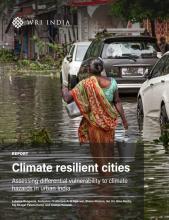
Climate Resilient Cities: Assessing Differential Vulnerability to Climate Hazards in Urban India
The report highlights the need to integrate equity into climate action planning in Indian cities. It examines how socioeconomic inequality and marginalization shape climate risks.
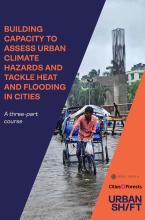
Building Capacity to Assess Urban Climate Hazards and Tackle Heat and Flooding in Cities
These three interconnected courses are designed to build the capacity of city officials and urban practitioners to conduct vulnerability assessments.
